Showing posts with label RMS. Show all posts

Sunday, 5 October 2008

Metallica "Death Magnetic" - Vinyl sounds better than CD. But not much.


To cut a long story short:

The vinyl LPs of "DeathMagnetic" sound better than the CD release. 

Not by a huge margin - they were clearly made from the same, heavily distorted original mixes, but despite this they sound a little more real, more dynamic, more spacious and (yes, really!) more exciting

That's the good news. The bad news is that the difference isn't that huge, and not all the tracks sound much better - there is more difference on some than on others. And also, the versions I listened to are the $100 5-LP set. So not only do you need a turntable to listen to them, but they aren't cheap.

There are however several fascinating questions which are raised by this, of which the most controversial is:

Did the CD mastering actually make the sound worse ?

Of course "worse" is a subjective term, but I'll explain what I'm hearing in more detail below.

What makes Death Magnetic (on CD) sound the way it does

There are three major factors that contribute to the overall sound of the Death Magnetic CD:
  1. The mix - hard, raw, dry, with very litle reverb. This is Rick Rubin's signature sound on this kind of material, and undoubtedly is the way the band wanted the album to sound. Even the "Guitar Hero" mix that many fans prefer shares this sound.
  2. Distortion - the CD release is massively distorted, especially the drums and the bass. This harsh type of distortion is made by a process known as "clipping" - in this case it sounds like analogue or "soft" clipping, probably from overdriving valve circuitry, channels on the mixing desk or similar. This distortion is mostly absent from the "Guitar Hero" mix, but mastering engineer Ted Jensen's claims the "artistic" decision to make the record sound like this happened at the mixing stage.
  3. Digital clipping - caused by lifting a digital signal above it's theoretical maximum level. Although it is also a form of distortion, on a record this distorted to begin with, it's debatable whether this would actually be audible as such - it tends to have a more thin, "fizzy" quality which is probably mostly masked by the crunchier, cracklier analogue distortion discussed above. However it has other effects on the sound - in small quantities it can allow additional level boosts without major distortion and loss of punch. If overdone though, or used on signals that are already very loud, it can actually have exactly the opposite effect. Unlike the mix and analogue distortion, it's not possible to know with any certainty whether this clipping occurred at the mix, master or both.
Or rather, it wasn't possible (for me, at least) until now.

Why listen to the vinyl ?

There has been discussion from the outset on the Metallica forums and elsewhere that perhaps the vinyl release would sound better than the CD. This doesn't rely on any purist audiophile belief that vinyl is better per se, but simply stems from the fact that vinyl releases are typically mastered separately from the CD versions, partly to take into account the pros and cons of each format, and partly because engineers often specialise.

This means there is scope for a vinyl version to sound different:
  1. Because it was mastered (or "cut") for a different format
  2. Perhaps by a different engineer
  3. Perhaps from a different mix
This last possibility was the one that had the fans really excited, but it was quickly established that it wasn't the case - the crackly analogue-sounding distortion was on the vinyl, too. At this point most people lost interest, and in fact many commented bitterly on the fact that the much-touted "audiophile" release, pressed on limited edition heavy vinyl at 45rpm for the best possible quality, suffered all the problems of the vanilla CD.

However as time went on, several people started saying that the vinyl was better in some ways, even though the distortion was still there. One chose to send me a couple of high-quality FLAC extracts to listen to, to get my opinion of them.

How does the vinyl sound ?

My first move was to listen to the same track I've used in my other comparisons - "The Day That Never Comes". I quickly established that indeed, the same mushy distortion covered the mix as the CD version. However discussion on the forums mentioned that different tracks sounded better than others, so next I chose one they highlighted as sounding clearly better - "All Nightmare Long". Before listening I used AudioLeak to calculate the long-term RMS loudness of both files, and reduced the CD version by 3.6 dB to match them. Comparisons without matched levels are highly unreliable. (The A-weighted values suggested a 5dB difference, but the CD sounded unfairly quiet to me at this level.)

After loading them up to ProTools, instantly I could hear a difference, even though I was just listening at home on headphones. Both were crunchy and distorted, but the vinyl version had more "punch", more weight in the drums, and the bass was clearer and more defined - even though the mix overall had less bottom end in it, the notes were more clearly audible. This was especially obvious during the more "full-on" sections, where the CD version suffered noticeably in comparison. After listening a little longer, I found I had a strong preference for the vinyl version. 

Returning to "The Day That Never Comes", I can hear the same difference, and draw the same conclusions, although the distortion from the original mix is so extreme it doesn't jump out at you in quite the same way. In comparison the CD sounds flat and lifeless. I'm still not keen on the distortion, but of the two versions I would choose the vinyl to listen to.

The difference between the vinyl and CD

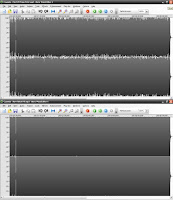
Waveforms aren't proof in cases like these - there are lots of reasons the vinyl might look different. In fact though, they are remarkably similar. Having looked at the waveforms of the CD before, I was pretty sure of what I would find, but zooming in on the waveform confirmed my suspicions.


The upper (CD) waveform is digitally clipped or "squared off", as expected, but the unexpected part is the vinyl version - it's a very unusual, unnatural shape because of the distortion, but it's not squared off. This explains why the vinyl sounds better - although harsh, the analogue distortion hasn't completely removed all the remaining dynamics. Extreme digital clipping of this kind on the other hand, where the whole wave becomes almost square, obliterates pitch information - the ear can't resolve the original fundamental or it's harmonics. Impact and punch are lost, too - the result sounds two-dimensional and plastic in comparison.

Some people on the Metallica forums expressed the opinion that the extra "peak" information on the vinyl didn't represent "real" musical information, simply the inherent difference in the format. Initially, I was inclined to agree, but after doing these listening tests myself I don't agree - the vinyl is less clipped than the CD and sounds better as a result.

Put another way: True, we are only talking about 3-4 dB extra dynamic range. But most of the CD tracks have a "loudness range" of only 3dB RMS anyway. So the vinyl has roughly twice the loudness range of the CD.

More questions

There are various differences between the vinyl and CD versions, as I would expect of two different masters for different formats. The CD sounds slightly thicker and fuller, without quite as much edge, and perhaps slightly more compressed. However the most noticeable difference is in the levels - there is 3.6 dB RMS between the vinyl and CD versions, even though both are peaking at full digital level. This means someone somewhere decided to boost the CD version by a further 3.6 dB, and digitally clip it in the process. (It's possible a digital limiter might have been used, but it looks like a straight clip.)

The question is who, and why ? The RMS measurement of of the vinyl version is -8.5, which is right at the top end of the loudest you can go without damaging the sound, and it already has the harsh, aggressive, distorted sound it seems that Rick Rubin wanted. So as a mastering engineer, I would see no reason to boost it further - simply balancing the EQ and levels of the tracks would be fine, and I'm sure Ted Jensen would have the same opinion.

So, were the files supplied to Sterling Sound already clipped ? Ted says they were "already brickwalled" - does he mean in a digital sense, as well as the analogue distortion ? Or, was he pushed to make the CDs even louder than the mixes, to the detriment of the sound ? He says he "would never be pushed to overdrive things as far as they are here". In which case, were the files that were supplied for CD mastering clipped more than the ones used for the vinyl ? If so, why ? There seems to be no logical reason for doing that, at all. Perhaps new, cleaner files were supplied for the vinyl cut in response to the unfavourable public reaction to the CDs ?

(Edit - I have been told the CD and vinyl versions were released simultaneously, in which case this last suggestion doesn't hold water.)

Either way, it's a shame the CDs ended up this way - the clipping isn't enough on it's own to ruin the music, but in my opinion in the unfortunate case of "Death Magnetic", it really is the straw that breaks the camel's back.

Now, I wonder what the downloadable mp3 versions sound like...!


Thursday, 2 October 2008

DIY Mastering Part 5 - How loud is Too Loud ?

As regular readers of this blog will know all too well by now, I am firmly opposed to the so-called CD "Loudness Wars", where everyone tries to get their CD louder than anyone else's by pushing the recorded level higher and higher. This is ultimately a self-defeating process - the CD spec defines a mazimum recordable level, and the harder you push your music up against that level, the more squashed, flattened, crushed and ultimately distorted it gets. Meanwhile there is far less scope within the tracks on the CD for the contrast needed for a satisfying musical result.

BUT as a mastering engineer I spend a lot of my time lifting the level of people's music so that it can compete with the high levels of other CDs out there. And, as I've said in a previous post, I feel that this is actually a positive step for most albums.

How do I reconcile these two apparently contradicting views ? The answer is something I've also said several times before here:

Louder is Better, but Too Loud is Worse

By which I mean - every track (and group of tracks) has a "sweet spot", where it's loudness (and by implication compression, level, EQ etc) is just right. It sounds the best it can be. If it's not compressed enough, then quiet passages won't have enough presence, the mix may not "gel" or have enough impact, detail may be lost, and loud passages will make you wince. Whereas if it's too loud and compressed it can sound squashed and dull (meaning bland and lifeless, not lacking treble) and ultimately fatiguing.

If the idea of using compression on a mix surprises you, it's worth knowing that as a rule of thumb people tend to like quite loud, compressed music, especially for pop and rock. Rick Rubin, who produced Metallica's latest album "Death Magnetic" (currently being heavily criticised for it's excessively-squashed, distorted sound) said in an interview from 2004:

I wish I had examples here to play for you. If I knew we were going to talk about this I’d go through the library and find examples. Ultimately, if you listen on a car sound system or in the mainstream place where most people listen to music—cars, boomboxes sound systems you get at (chain stores), and if you “A/B” the less compressed version to the more compressed version, you pick the compressed version.

And he's right ! He also says, in response to a question about things sounding better on the radio:

Sometimes actually, if it’s too loud, it sounds worse on the radio.

And again, he's right. Sadly, this is exactly the case with Death Magnetic. Clearly this is a delicate issue, and one that even the most respected engineers sometimes misjudge. Music needs just the right amount of compression and level, based on the style of music and the original recording.

So, how loud is Too Loud ? Where do we cross the boundary from sweet-spot into overcooking ? The answer of course is -

Something is Too Loud when it starts to sound worse

But what is worse ? Everything is subjective. Rubin obviously thought Death Magnetic sounded good when he was working on it - perhaps he still does. Lars from Metallica has no problem with it, but I and many others think it's a great shame that so much distortion had to be introduced.

Loudness Measurements

Ultimately the only real way to judge this is to use your ears, but for what it's worth, here are a few facts and figures. I have analysed the loudness of several tracks using a free Mac utility called AudioLeak to measure their long-term A-weighted RMS level. RMS stands for "root mean square" and as applied to music roughly describes the loudness of a musical signal. A-weighting improves on this by taking into account the fact that the ear is less sensitive to bass and treble when judging loudness, and provides a better guide to how loud we think things. A track of equal "raw" RMS level but with more bass won't sound quite as loud, for example, and so will have a lower A-weighted RMS.

Here are some example A-weighted RMS level measurements, with raw RMS in brackets - they are long-term measurements, ie. average values over an entire track. The highest theoretical value possible is zero, and slightly confusingly they are measured down from there, so -10 is louder than -12, for example. So, with the loudest at the top, we have:

-8.6 (-6.2) Oasis - "Some Might Say": Severe clipping distortion
-8.9 (-4.9) Metallica - "TDTNC" (CD): Massive distortion & clipping
-10.4 (-7.7) Feeder - "Pushing The Senses": Heavy clipping distortion
-12.7 (-7.7) Metallica - "BB&S" (Mystery Mix): Slight source clipping
-14.0 (-10) Katatonia - "Consternation": Awesome (clean) sound, massive choruses
-15.3 (-13.1) Sugar - "Fortune Teller": From 1993
-21.8 (-16.9) Metallica - "TDTNC" (GH3) Needs to be louder !


There are plenty of interesting things to be seen looking at these numbers - firstly, the Oasis track actually measures fractionally louder than Metallica ! However by looking at the raw RMS values we can see that in brute power terms Metallica has a higher level - they just have more low-frequency in the sound than Oasis, so the A-weighted value doesn't reflect that. This higher raw RMS may also explain why the distortion on the Metallica tracks is even worse than on Oasis.

Looking at these tracks it would seem that with care the A-weighted RMS can actually be pushed as high as -12 dBFS without obvious distortion. Whether the result is satisfying musically, the numbers can't tell us, though. In my opinion the two best-sounding tracks here are Katatonia and Sugar - "Copper Blue" was a loud album for it's time, but look how things have changed. (By the way examining some SRT masters, the A-weighted RMS typically hovers around - you guessed it, -14 to -12 dBFS)

So, is the answer to "how loud is too loud" actually "any higher than an overall level of -12 dBFS RMS, A-weighted" ?

Well, if we're judging "too loud" to mean "the onset of distortion", then for guitar-driven rock music, yes, maybe. However other genres may suffer more or less and we need to bear in mind that rock is a highly compressed, distorted genre to begin with. I prefer a more dynamic sound personally, so I would pick a level closer to -14 - if it suits the music. Once again, at the end of the day we need to use our ears to make these judgement calls.

Understanding Loudness Measurements

It's also interesting to think about what these numbers mean. The Katatonia track is only 2dB (RMS) quieter than the "Mystery Mix" of Broken, Beat & Scarred", but still has more punch, weight and impact, to my ears. This difference is vastly more apparent comparing to the Metallica CD, and looking at the numbers we can see why. Katatonia has maximum RMS of -8 dB, in the track, compared to an average of -14, giving it a "loudness range" of 6dB.

Compare that with the "Death Magnetic" track. The highest raw RMS level in the track is -2.5 dB. But the average is an eye-watering -4.9, allowing it a range of only 2.4 dB. So the loudest parts can be only 2.4 dB louder than the rest of the track. Katatonia has almost three times the loudness range to play with. No wonder TDTNC sounds flat and lifeless by comparison, whereas when the chorus kicks in on "MyTwin" the impact and buzz it generates is huge. And with almost 10dB to play with, it's obvious why the Guitar Hero version has so much more punch and life - and in fact in my opinion, it would benefit from some EQ and being at a higher level and more compressed, to get it into the "sweet spot". This is why despite preferring the reduced distortion, some listeners still find it lacking.

Ultimately the decision about when the music starts to suffer at the expense of level is one of taste, and requires a judgement call by all concerned. However looking at RMS levels as we have here can be very revealing for a mastering engineer, so I strongly recommend you experiment with AudioLeak or another form of loudness metering - like all mastering facilities we use them constantly here at SRT when mastering. I also recommend you stick around the -14 dBFS A-weighted RMS level to ensure that your CDs are both competitive but also loud-sounding in their own right.

Sunday, 14 September 2008

Metallica "Death Magnetic" Clipping Distortion

Those of you keeping an eye on the "Loudness Wars" may be interested by current discussions on the Metallica forums. Fans have been complaining bitterly about the extreme clipping distortion on the new album "Death Magnetic" - it's clearly audible on the previews in iTunes, for example - and the finger has been pointed at Ted Jensen, head engineer at Sterling Sound, who mastered the album.

In an interesting turn of events, however, user "oneway23" has posted what he claims is a reply from Ted, stating that the album was supplied to him with the clipping already in the mix:

I’m certainly sympathetic to your reaction, I get to slam my head against that brick wall every day. In this case the mixes were already brick walled before they arrived at my place. Suffice it to say I would never be pushed to overdrive things as far as they are here. Believe me I’m not proud to be associated with this one, and we can only hope that some good will come from this in some form of backlash against volume above all else.

Check out the thread for yourself:

I GOT A RESPONSE FROM TED, JENSEN wrote back...He's not happy

Assuming this is genuine, props are due to Ted for sticking his neck out and saying what he believes. However things may not be quite that simple. A version of the album was leaked via BitTorrent in the weeks before release, with people already complaining about the way that it sounds. Analysis of the waveforms shows that the released version is even louder than the leaked version:

Death Magnetic - Wave Form Analysis

(Edit to add: The seems to be some controversy about these waveforms, with various alternative versions floating about. I will check them out myself as soon as possible. )

Additionally, as my colleague Simon Murphy notes, there are several different types of distortion in the released version, some of which (for example of the snare only) can only have been incurred during tracking or mixing, but others which may have been introduced in mastering.

Analysis of the levels in the tracks shows it is VERY loud. Great-sounding albums typically average an RMS loudness of -16 to -12 dB RMS, however in recent years louder albums have pushed much higher, for example -8 or -6 dB RMS. Here is one mastering engineers analysis of Death Magnetic:

I just skipped through 3 random songs and the highest I saw on the meter was -4,3 dB RMS (-1,3 RMS in AES17 norm), looking at the realtime RMS meter with Wavelab's default time constants.

Wavelab's global analysis (with its default time constants) reports -2,93 RMS [+0,07 in AES17] RMS in one of those tracks.

Most of the album (looking at the meters) sits between -7 and -5 (between -4 and -2 in AES17).

You remember that popular myth that mastering will "make your record sound the same across different systems"? I now get the point. Death Magnetic (although apparently not introduced through mastering) sounds thin and distorted on my laptop speakers. And it sounds thin and distorted in my mastering studio. There's always a silver lining

In a further bizarre twist, some fans are now claiming that the version of Death Magnetic used in the popular Playstation 3 game "Guitar Hero" sounds better than the released version:


Strange as it may sound, this suggestion actually has some credibility - in order to have versions of new releases available at the same time as the album release, Guitar Hero developers have very early access to the music, and additionally have a certain degree of control over the individual tracks to ensure it works in a game environment. Fans are now discussing "ripping" the versions contained in the PS3 version, and creating their own, less distorted version of the album.

(Edit to add: I have now been able to compare samples of both versions, and have made a new post with my conclusions here. There is a detailed comparison of the differences in sound here.)

Whatever the truth of the matter, from Ted's public statement it's clear he was persuaded to push the album louder than he wished, probably by the band, and against his better judgement. Sadly this is quite common in modern mastering, where the myth that "we need to be louder than everybody else" persists far beyond it's sell-by date.

As someone on the Gearslutz Mastering Forum commented recently, most people don't care about the RMS loudness, they just turn it up - have you ever heard anyone complain that Nirvana's "Nevermind" was too quiet, for example ?

There have been plenty of clipped, distorted albums before, sadly - Oasis' "What's The Story Morning Glory" was one of the first, for example. What's interesting and unusual about this case is the furious reaction from the fans, and the media coverage that will almost certainly follow.

Will this backlash help turn the tide in the Loudness Wars ? We can only hope.

Thursday, 15 May 2008

Mastering Software Part 1 - Metering Levels and Loudness

I mentioned the Orban Loudness Meter on the SOS forums, and thought it would be good to start a series of posts here on useful mastering software. So, first up - metering apps. Several of the best editing packages include decent metering, for example Wavelab, and Audacity, but here are a few personal favourites:
  •  Orban Loudness Meter Great (free!) utility includes a PPM meter, VU meter, ITU BS.1770 meter and CBS Technology Center loudness meter - it's fantastic to have access to these less common metering systems, which offer measurements of perceived loudness, which can be more useful than pure RMS. (Plus it runs well under Parallels on my MacBook Pro ;-) 
  • Pinguin Audio Meter Not free but comes in several flavours, the Pro version includes an incredibly detailed spectrum analyser, audio phase correlator (more in a later post), PPM & VU monitoring plus a specrogram. Interestingly, Pinguin have done research to suggest that RMS is the most reliable way of measuring perceived loudness.
  • Speaking of Spectrograms, there's Spectrogram - and Audacity has this capability, too.
  • Finally, the fantastic (Mac-only) AudioLeak - an Leq (Long-term Equivalent Level) Analyzer for audio files and sound input streams. Swiftly discover the average RMS of an audio file, and it's A-weighted counterpart. Just watch out - by default it displays a combined mono value which reads higher than other applications like Wavelab - I usually use the average of the left & right values - they should be almost identical if the L/R balance is right, anyway. Also great for DVD Producers wanting to find the right dialnorm setting for a Dolby Digital encode.
  • Update - here's another one - the SSL X-ISM meter. This is useful because it includes checking for inter-sample peaks. This is well-explained on the page I linked to, but briefly: strange as it may seem, when audio has been heavily limited and is peaking at (or very near to) zero, it is possible that the reconstructed analogue output actually peaks above zero. (In theory, up to 6 dB higher !) In cheaper players, MP3 encoders and other utilities, there is often no headroom allowed for this situation, and unwanted clipping can result. This meter will help you watch for this effect and avoid it. As a rule of thumb, don't allow your audio to peak higher that -0.3 dBFS.
Coming soon - how to choose a mastering studio.